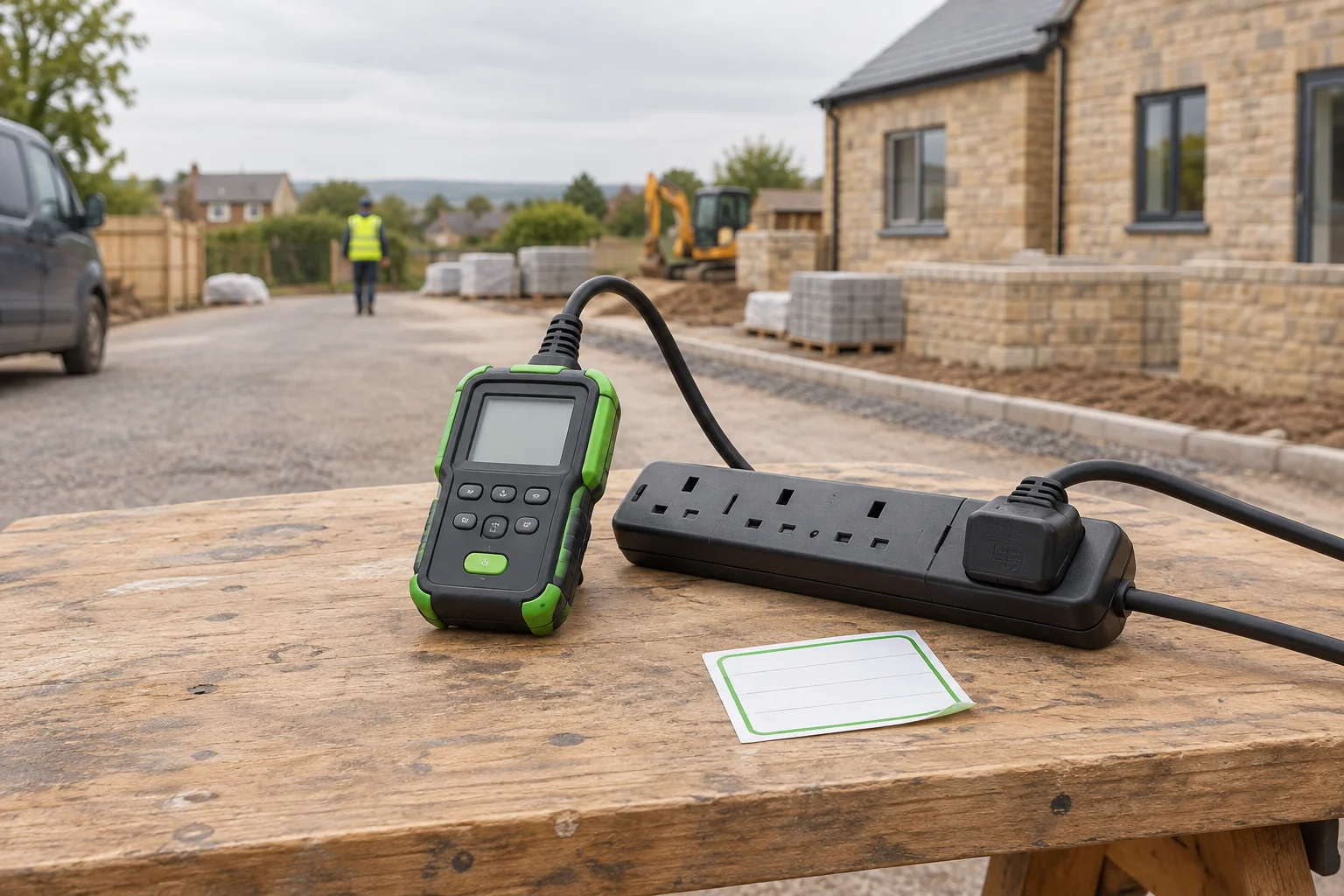
More electricians are adding portable appliance testing to what they offer. Customers then ask what paperwork they get. Some ask whether the law says they must have it at all. The honest answer is that the law is looser than many people think, but good records still protect you and the customer.
This post is general information, not legal advice. Your own situation may differ, so check the official pages linked below.
What PAT testing is
Portable appliance testing (PAT) is the term for examining electrical appliances and equipment to make sure they are safe to use. The HSE (Health and Safety Executive) says a visual examination is essential, because some defects can't be found by testing alone. Other defects can only be found by testing. So a proper job usually combines both.
Is PAT testing a legal requirement?
The Electricity at Work Regulations 1989 require that electrical equipment that could cause injury is maintained in a safe condition. That is the legal duty. The HSE's guidance is clear on what the Regulations don't do:
They don't say what has to be done, by whom or how often.
They don't make inspection or testing of appliances a legal requirement.
They don't make annual testing a legal requirement.
The HSE's leaflet on low-risk environments, such as offices, shops and some parts of hotels, calls it a myth that every portable appliance needs a PAT every year. So if a customer says the law demands yearly testing, you can point them to the HSE's PAT questions page.
That doesn't mean testing is never expected. The HSE says more formal inspection and testing by a competent person may be required at appropriate intervals, depending on the type of equipment and where it is used. A customer's insurer, landlord or main contractor may also have its own requirements. Ask what they expect before you quote.
How often should equipment be checked?
There is no single answer. It depends on the equipment and the setting. The HSE's example is that a power tool on a construction site should be examined more often than a lamp in a hotel bedroom. For suggested intervals, the HSE points to its publication HSG107, Maintaining portable and transportable electrical equipment.
The HSE also gives a worked example of a risk-based approach: a visual inspection every 5 years for low-risk office equipment that is rarely moved. That is an illustration, not a rule. Don't quote it to a customer as the required interval.
New and hired equipment
New equipment should be supplied in a safe condition and shouldn't need a formal PAT. The HSE still recommends a simple visual check for damage. For tool hire, the HSE strongly recommends that suppliers formally inspect and test equipment before each hire, and that the hirer takes steps to keep it safe during the hire.
Do you have to keep PAT records?
No. The HSE says there is no legal requirement to keep records of inspection and testing, and none to label equipment that has been tested. But it also says a record, a label or both can be a useful management tool. They help the customer monitor and review their maintenance scheme, and they show that a scheme exists.
For you, that second point matters. If a customer later has an incident with an appliance you tested, a clear record shows what you looked at, what you found and when. Without it, it's your word against theirs.
What to write down for each test
The HSE doesn't set out a required format in the pages we have used. The list below is a practical suggestion, not an official rule. Keep it simple enough that you will do it every time.
Customer name, the site address and the date of the work.
A description of each item, with a serial number or your own reference where it has one.
The result of the visual examination.
The result of any electrical test, with a clear pass or fail.
What you did about anything that failed, for example removed from use or repaired.
Your name, and a suggested date for the next check, with your reasoning if the customer asks.
A matching label on the item, if you and the customer agree to use labels.
Give the customer a copy and keep your own. A photo of a failed item, with the date, can save an argument later.
Who can do the testing?
The person must be competent. The HSE says that in many low-risk settings a sensible member of staff with enough knowledge and training can do visual inspections. Combined inspection and testing needs more knowledge and experience. The tester also needs suitable test equipment, the ability to use it properly and the ability to understand the results. The page doesn't say that only an electrician may do PAT, so don't tell customers that.
If you take this work on, be honest about your experience and keep your test equipment in good order. That is part of being competent.
How long to keep the records
The HSE pages on PAT don't give a retention period for test records. There is no official "keep for X years" figure for them, so don't promise one to a customer.
Your tax records are a separate matter. The invoice and payment for the PAT work are business records for your tax return, and different rules apply to those. Check GOV.UK's guidance on keeping business records, or ask an accountant, for how long you must keep them. A sensible habit is to keep the test record for at least as long as you keep the invoice, so the two can be matched.
Keeping it all together
If you run jobs in Quidjob, you can keep the job notes and test results with the job and send the invoice from the same place. The customer pays by bank transfer from the invoice link. A quote that says what you will test, and what record they will get, also avoids disputes about what was included.
Wrapping up
PAT testing and PAT records aren't a blanket legal requirement, but equipment must be kept safe, and a clear record is the easiest way to show that it was. Ask what the customer expects, check the HSE's guidance on intervals, write down what you find, and keep a copy. For fixed wiring certificates, see our guide on EIC vs EICR.