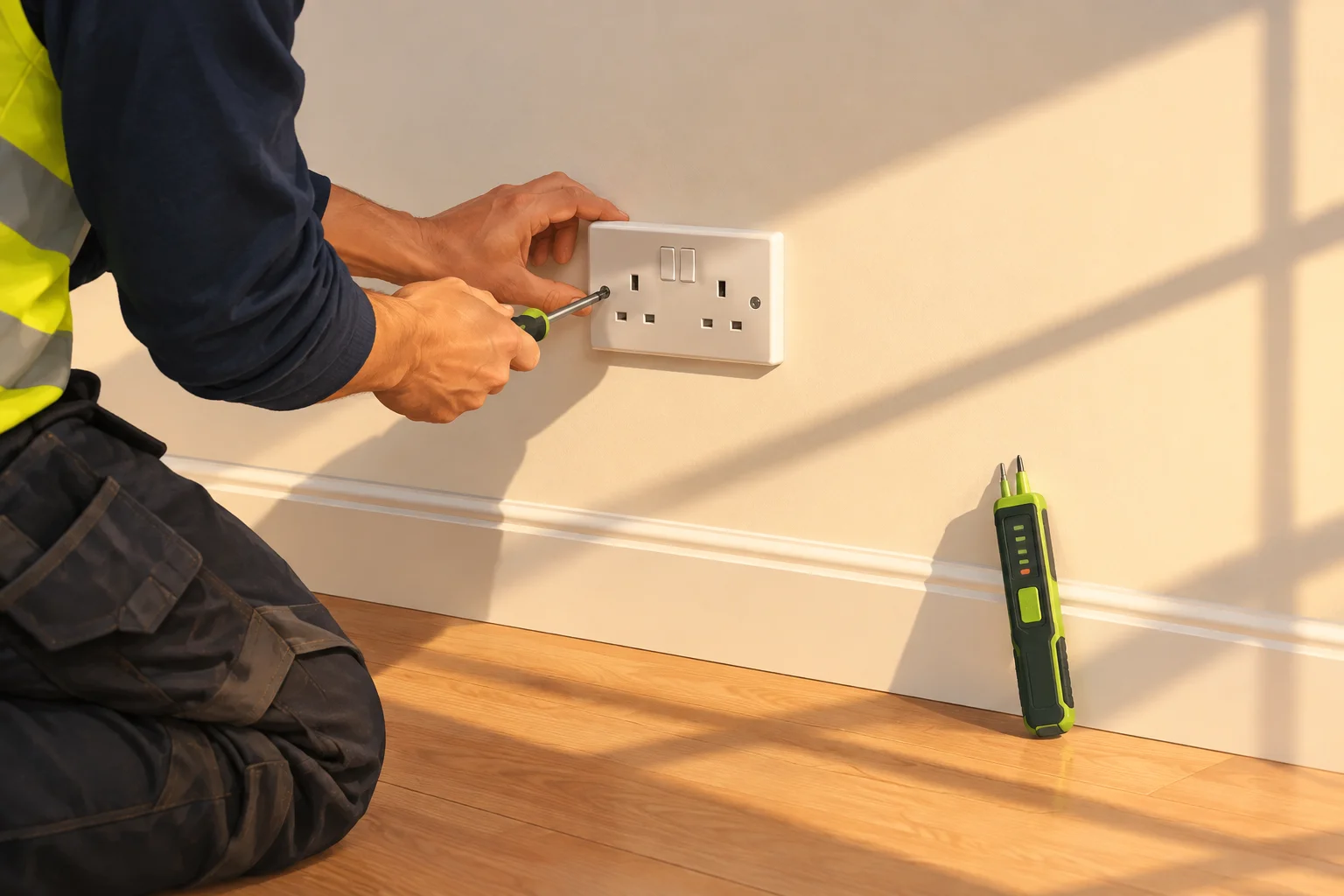
A customer asks you to swap a damaged socket or put up a new light fitting. When you finish, they ask, 'Can I have a certificate for that?' It is a fair question, and the rules are easy to muddle. There are two separate ideas: whether the job is notifiable (it has to be reported to building control, or by a registered competent person), and whether it should be certificated (tested and recorded on a BS 7671 form). Small jobs are usually not notifiable. That does not mean they need no paperwork.
This post covers dwellings in England. Wales has its own Approved Documents, so check the Welsh position if you work there. It is general information, not legal advice.
Part P applies to all electrical work in a home
Part P is the part of the Building Regulations that covers electrical safety in dwellings. GOV.UK says that all electrical work in a dwelling must be carried out in line with Part P. That includes jobs that are not notifiable. So 'it's only a socket' is not a reason to cut corners on the work itself.
The detail sits in Approved Document P, the official guidance. The notes below follow the 2013 edition. Check the GOV.UK page for the current edition before you rely on any paragraph number.
When a small job is notifiable
Notifiable work is set out in regulation 12(6A) of The Building Regulations 2010. Approved Document P (paragraph 2.7) and GOV.UK's Building Regulations guidance describe it in plain terms. The jobs that matter most for small work are:
Installing a new circuit.
Installing a new or replacement consumer unit (the fuse box).
Alterations and additions in a special location: the area around a bath or shower. Here even minor additions to an existing circuit are notifiable. Diagram 2 in the Approved Document shows the zone and its dimensions.
If your job falls into one of those, you need to be a registered competent person (someone registered with a competent person scheme who can self-certify), or you must notify a building control body before you start. You can also use a registered third-party certifier. GOV.UK explains third-party certification schemes, which have been available since 6 April 2014.
When a small job is not notifiable
Paragraph 2.7 of the Approved Document says other electrical installation work is not notifiable. That means additions and alterations to existing installations outside special locations, and replacements, repairs and maintenance anywhere. The 2013 edition cut the range of notifiable work. Kitchens, outdoor work and control wiring dropped out.
Putting that together, here is how it works for typical jobs:
Swapping one socket or light fitting like for like, in any room: a replacement, so not notifiable.
Adding a socket or light to an existing circuit in a living room or kitchen: an addition outside a special location, so not notifiable.
Adding a socket or light to an existing circuit within the bath or shower zone: notifiable.
Any new circuit, wherever it is: notifiable.
The Approved Document also gives examples. Installing a built-in cooker is not notifiable unless a new cooker circuit is needed. Connecting an electric gate to an existing isolator is not notifiable, but a new circuit from the consumer unit to that isolator is. Fixed equipment is within the scope of Part P even if the final connection is a 13A plug and socket (paragraph 2.8).
Do you have to give a certificate for non-notifiable work?
Approved Document P paragraph 3.13 says non-notifiable work should still be designed, installed, inspected, tested and certificated in line with BS 7671, the wiring regulations. It says 'should', and I have not found a rule in the official guidance that says 'must' for this type of job. Treat it as the standard you are expected to meet. If a local authority finds non-notifiable work that is unsafe and non-compliant, paragraph 3.14 says it can take enforcement action.
The guidance also says registered competent persons should complete a BS 7671 electrical installation certificate for every job and give it to the person who ordered the work (paragraph 3.3). The BS 7671 forms include models for work from minor jobs to large projects. For an addition or alteration that doesn't include a new circuit, BS 7671 provides the Minor Electrical Installation Works Certificate; work that adds a new circuit needs the full Electrical Installation Certificate.
Whatever form you use, give the completed inspection and test paperwork to the person who ordered the work. Keep a copy of your own.
What happens with notifiable work
For notifiable work done by a registered competent person, the installer or their registration body must do two things within 30 days of completion (paragraph 3.4):
Give a Building Regulations compliance certificate (or a copy) to the occupier.
Give the certificate, or its information, to the building control body.
In rented homes the certificate may go to the person who ordered the work, with a copy to the occupier. If you are not registered and have not appointed a registered third-party certifier, you must notify a building control body before you start (paragraph 3.8).
Safety law applies as well
Separately from the Building Regulations, the Electricity at Work Regulations 1989 apply to electrical work in domestic premises. Regulation 4 covers systems and work activities. The point is simple: a small job must still be safe, and you should be able to show what you tested. For the difference between the certificates you may hand over, see our guide on EIC vs EICR.
A simple habit for small jobs
Decide before you start whether the job is notifiable. Check for a bath or shower zone and for any new circuit.
Test the circuit before and after, and record the results.
Complete the right BS 7671 form and hand it to the customer.
Keep a copy with the job record. If you use Quidjob, you can note the certificate against the job and the invoice so it is easy to find later.
Wrap-up
Replacing one socket or light fitting is normally not notifiable in England, but Part P still applies and the guidance says the work should be tested and certificated. Check for special locations and new circuits, hand over the paperwork, and keep a copy. If a job is on the edge, ask your scheme provider or building control before you start.