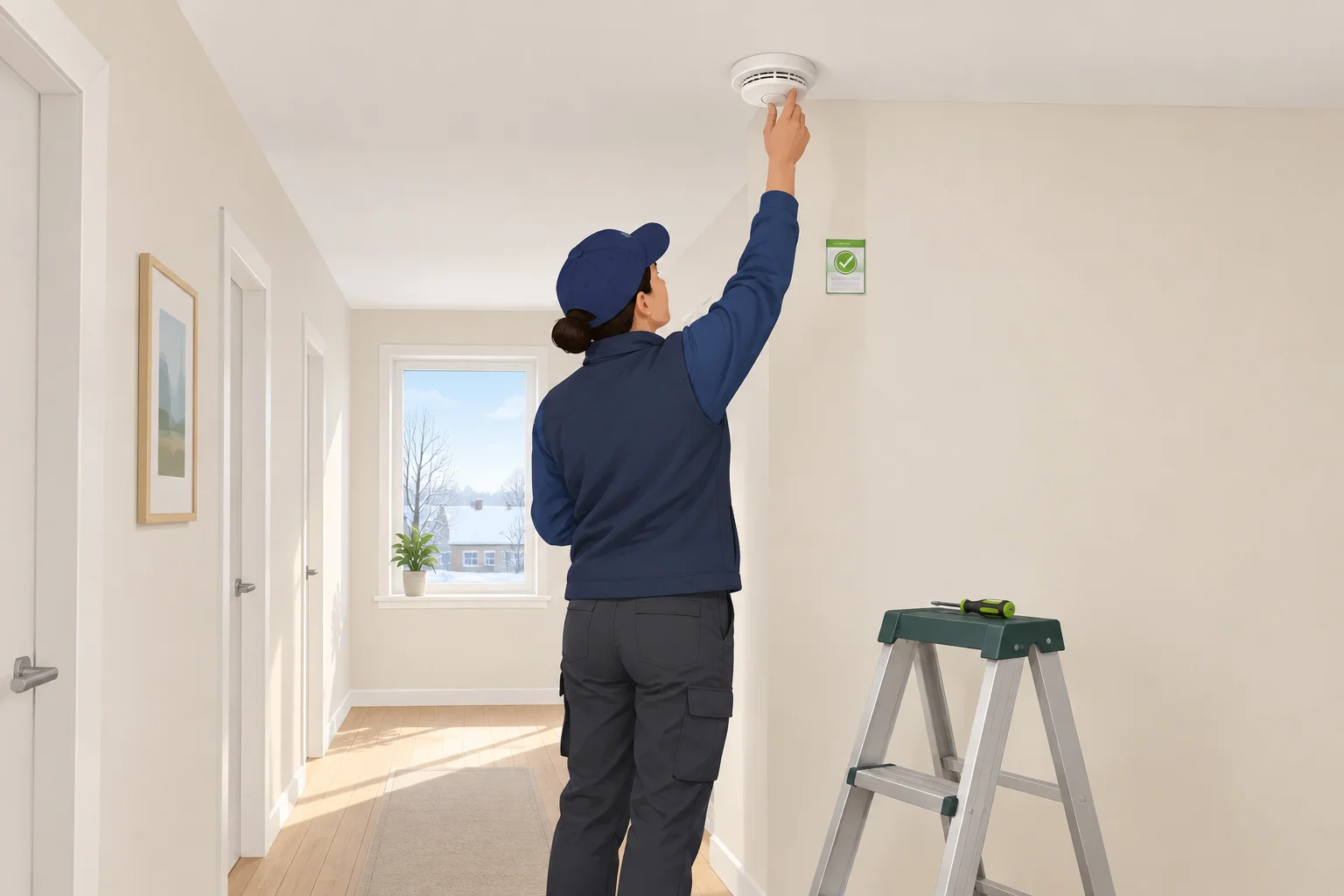
A landlord has had you fit a smoke alarm, or a carbon monoxide (CO) alarm, in a rented flat. Then they ask: "Can I have a certificate for that?" It is a fair question, because they may need to show a council they have done the job. But the answer is not the one most people expect. This post sets out what the rules say, what is useful to hand over, and where other paperwork does apply. It covers England only, and it is general information, not legal advice.
What the law asks of the landlord
The duties sit with the landlord, not with you. Under regulation 4 of the Smoke and Carbon Monoxide Alarm (England) Regulations 2015, a private landlord must make sure a smoke alarm is fitted on each storey of the property that has a room used wholly or partly as living accommodation. A bathroom or lavatory counts as living accommodation for this purpose. The landlord must also make sure checks are made, by them or on their behalf, that each alarm works on the day a new tenancy begins.
The rules were changed from 1 October 2022 by the Smoke and Carbon Monoxide Alarm (Amendment) Regulations 2022 (SI 2022/707). Since then:
A CO alarm is needed in any room used as living accommodation that has a fixed combustion appliance. Gas cookers are excluded.
Social landlords are covered as well as private ones.
If a tenant reports that an alarm isn't working, the landlord must repair or replace it. The explanatory memorandum to the 2022 regulations says this means "as soon as reasonably practicable".
The local housing authority (the council) enforces all this. If a landlord ignores a remedial notice, they can face a fine of up to £5,000. GOV.UK guidance says the fine is per breach.
So is there a certificate?
Regulation 4 doesn't mention a certificate, a document or any record from the person who fits the alarm. It doesn't say who must do the fitting or testing, and it doesn't set out a form. So there is no statutory "smoke alarm certificate" that you are required to issue.
The duty to keep a record falls on the landlord. GOV.UK guidance for landlords and tenants says: "It is the responsibility of landlords to keep a record of when alarms are tested." It also says the council decides whether the landlord's evidence shows they have complied. Its one example of evidence is a tenant signing the inventory on day one to confirm the alarms were tested and work. The guidance describes itself as not an authoritative interpretation of the law.
Put simply, your written record is useful evidence for the landlord. It is not a certificate required by law. That is a good reason to give them one anyway, and to call it what it is: a job record or invoice, not a "certificate of compliance".
A heat alarm is not a smoke alarm
Landlords sometimes ask for a heat alarm because a kitchen triggers false alarms. That is fine as an extra. But GOV.UK guidance is blunt: "Heat detectors are not a replacement for smoke alarms." If a heat alarm is the only thing you fit on a storey, it does not meet the smoke alarm duty. Say so on your record, and tell the landlord in plain words.
What to put in your written record
The regulations don't prescribe the type, the power source or the position of alarms. GOV.UK guidance does recommend smoke alarms to BS 5839-6 and CO alarms to the CO alarm standard (BS EN 50291). It suggests sealed-for-life batteries as the better option where battery alarms are used. Follow the manufacturer's instructions. In general, smoke alarms go on the ceiling in a circulation space such as a hall or landing. CO alarms go at head height on a wall or shelf, about 1 to 3 metres from the possible CO source.
A record that helps a landlord should show:
The property address and the date of the visit.
What you fitted or replaced: smoke, CO or heat alarm, and the make and model.
Where each one is, by storey and room.
Whether each is mains-wired or battery-powered.
The result of your test on the day.
Anything you did not fit, and why. For example, no CO alarm was fitted because there was no fixed combustion appliance in the room, or the landlord decided against it.
Your name, trading name and contact details.
Keep your own copy. If a dispute comes up months later, you will want to show what you did and when. Photos of each alarm in place are a cheap extra.
When other paperwork does apply
Mains-wired alarms
Fitting an alarm is one thing. Wiring it into the mains is electrical work. Approved Document P says notifiable work must be notified to a building control body, or certified by a registered competent person or registered third party. It refers to BS 7671 for the installation. Whether your particular job is notifiable depends on the work, so check the document before you decide. Our guide to EIC vs EICR explains the electrical certificates in general.
Gas safety records
If you are a Gas Safe engineer, remember that a gas safety record is a separate, statutory document for gas work. HSE says it must show the appliance details and location, your name, registration number and signature, the date checked, the property and landlord details, and any safety defect and action taken. Records must be kept for at least two years under regulation 36(3)(c) of the Gas Safety (Installation and Use) Regulations 1998. HSE's gas pages do not say the record covers fitting a smoke or CO alarm. So a gas safety record is not an alarm certificate. Our guide to landlord gas safety and EICR rules covers the gas side in more detail.
Wording to avoid and tenants to remember
Don't write that the property "complies with the regulations". You haven't checked the whole property or the tenancy start date, and that is the landlord's job. Describe what you did: "Fitted one smoke alarm to the hall ceiling and tested it on 25 October 2026." Stick to facts you can stand behind.
GOV.UK guidance also suggests landlords consider giving tenants a demonstration or instructions on testing. If you are on site when the tenant is in, a two-minute show of the test button is worth doing, and you can add a line to your record saying you did it.
These rules apply in England. Scotland, Wales and Northern Ireland have their own rules, so check the official guidance there if you work across the border.
Keeping the record tidy
The easiest approach is to put these details on the invoice or job record you already send. In Quidjob you can note the alarms fitted, their location and the test result on the job, and send the invoice from your phone. The customer then pays by bank transfer from the invoice link. That is a job record, not an official certificate, and you should describe it to the landlord that way.
Wrap-up
No law makes you issue a smoke or CO alarm certificate. The landlord must keep their own record, and your clear, honest job record can help them do it. Say what you fitted, where, and what the test showed. Never let a heat alarm stand in for a smoke alarm. And if the work involves mains wiring or gas appliances, check whether separate electrical or gas paperwork applies.