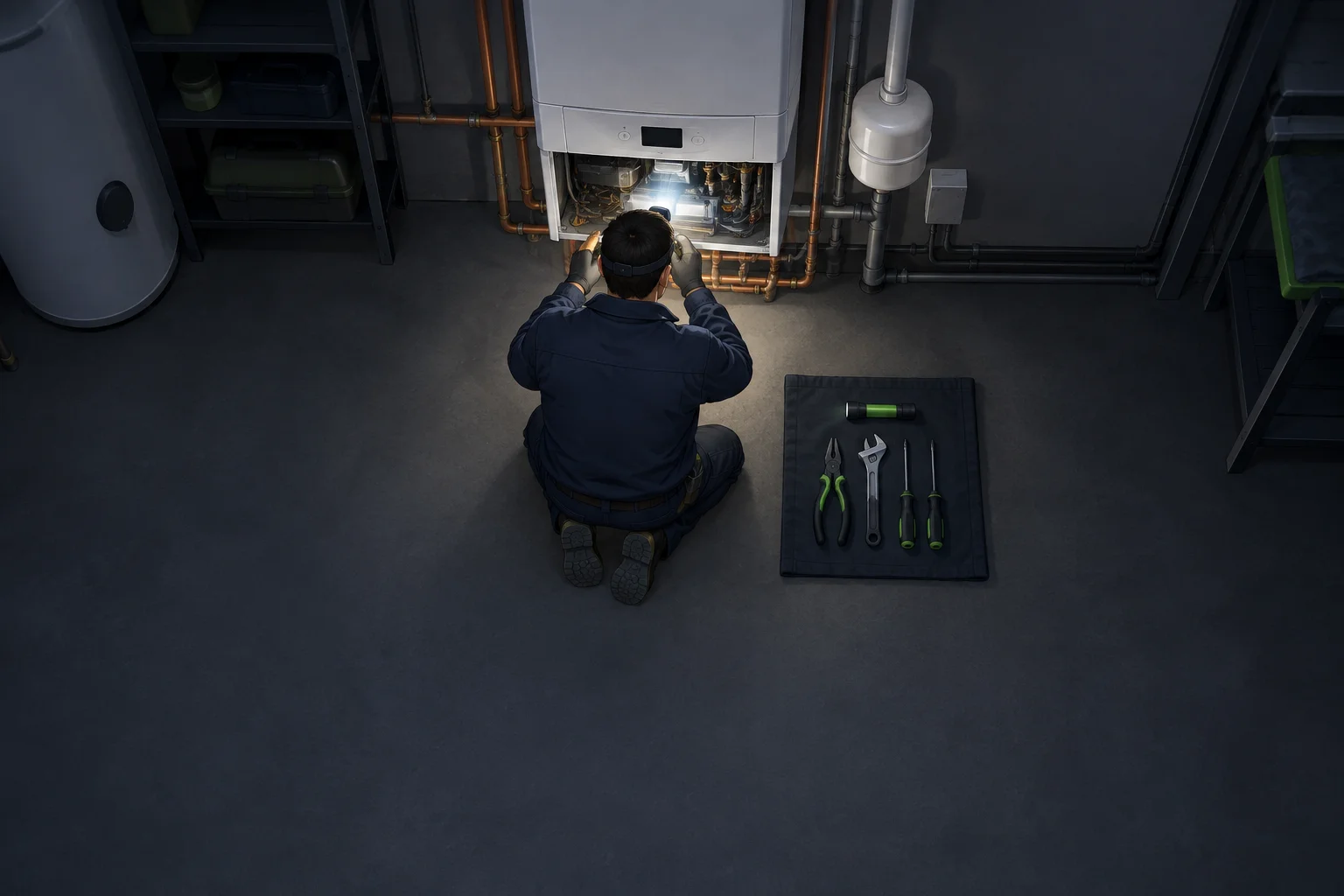
The phone goes at 8pm on a Saturday. A pipe has burst, or half a house has lost power. You say yes, drive across town, and by the time you are home you have lost your evening and the money you quoted barely covers it. Winter brings more of these calls. This post shows how to set a call-out charge that pays for your time and travel, and how to explain it so the customer is not put off.
What a call-out charge is really paying for
A call-out charge is not a payment for the repair. It pays for you being available and getting there. When you take an urgent call outside normal hours, you are paying for several things:
The time you spend driving there, which you cannot bill as work.
The fuel and wear on your van.
The evening or weekend you give up, and the other work or rest you turn down.
The extra effort of working late, often alone, in a house you do not know.
If your price only covers the hour at the property, you are quietly paying for the rest yourself. That is how a busy month of emergency calls can leave you worse off than a quiet one.
Work out your own numbers first
There is no official guidance on how much a call-out charge should be, so do not copy a figure from someone else. Build yours from your own costs. Start with travel.
HMRC (the tax authority) lets sole traders claim a flat rate per mile for business driving instead of working out actual costs. For the 2026 to 2027 tax year it is 55p a mile for cars and goods vehicles for the first 10,000 miles, then 25p a mile after that. Before 6 April 2026 the first-10,000-miles rate was 45p. You can claim parking on top. See simplified expenses for vehicles on GOV.UK.
That rate is what you can claim against tax. It is not a price to charge customers. But it is a handy rough floor for what a trip costs you. Here is an example with made-up numbers, so use your own:
The job is 12 miles each way, so 24 miles. At 55p a mile that is £13.20 of travel cost.
The drive takes about 25 minutes each way. That is 50 minutes of your time that nobody pays for.
You would otherwise be off work, so you want the evening time to be worth more than a normal hour.
Add those up and you see the real cost of just turning up. Your call-out fee should at least cover that, before you pick up a tool. Then decide your hourly rate for the work itself. For more on building a price from your costs, see how to price a job and protect your margin.
Agree and show the price before you set off
The safest habit is to tell the customer the price before you go. The law backs this up in two ways.
First, if you and the customer have not fixed a price or how it is worked out, the contract is treated as saying the customer must pay a reasonable price, and no more. What is reasonable is a question of fact, which means it can be argued about. See section 51 of the Consumer Rights Act 2015. Agreeing the fee and rate beforehand means nobody argues about it afterwards.
Second, the Digital Markets, Competition and Consumers Act 2024 updated the law on unfair trading, including price transparency. The Competition and Markets Authority (CMA) says prices should not be misleading and, wherever possible, customers should see the total price at the start. Showing a headline price and then adding charges they must pay is called drip pricing, and it is prohibited. Giving the parts of a price without the total, such as call-out fee plus hourly rate plus parts, should only be done where the total cannot reasonably be worked out in advance. The CMA's guidance is on GOV.UK as Price transparency. Check the current version there.
For an emergency, you often cannot know the total before you have seen the problem. So be clear about what you can say for certain, and do not leave anything out.
What to say on the phone and put in writing
Tell the customer these things before you leave, then send them in writing, in your quote or invoice link, so there is a record:
The call-out fee and exactly what it covers, for example arriving and a first assessment.
The hourly rate that applies after that, and when the clock starts.
Any minimum charge for the visit.
How parts will be charged, and that you will tell them before fitting anything expensive.
Whether the prices include VAT.
How they pay: by bank transfer, from the link on your invoice.
On VAT: you only have to add it if you are VAT-registered. You must register if your taxable turnover is more than £90,000, and you can cancel registration if it falls below £88,000. Check the VAT thresholds on GOV.UK. Either way, say whether your fee is with or without VAT so the customer is not surprised.
Explain it so it does not put people off
Most people accept a higher out-of-hours price when they understand it. What puts them off is a surprise. A few habits help:
Say the price early, in plain words: This is an out-of-hours call, so the call-out fee is this, and after that it is this much an hour.
Ask what is happening. If water is not actually pouring or the lights are on in the rest of the house, offer to make it safe now, or come first thing in the morning at your normal rate.
Be honest that you cannot know the final total until you see the problem, and say what you will do to keep it down.
Do not be tempted to undercut your own fee to win the job. A customer who is calling at 9pm is usually more worried about getting help than about the price.
Cancellation rights and urgent repairs
Customers who book a service from you at home normally have a 14-day right to cancel. For a service contract that period ends at the end of 14 days after the day the contract is entered into (regulation 30 of the Consumer Contracts (Information, Cancellation and Additional Charges) Regulations 2013).
There is an exception. Under regulation 28(1)(e), the right does not apply to contracts where the customer has specifically requested a visit from you to carry out urgent repairs or maintenance. But regulation 28(2) says the exception does not cover extra services beyond the urgent repair requested, or goods other than replacement parts necessarily used in the repair.
In practice, this means the customer must have asked for the visit, and the work must be genuinely urgent. A non-urgent job, or extra work added on the same visit, may not be covered. A Saturday booking for something that could wait until Monday is not clearly an urgent repair. If you are unsure, take advice from an accountant or read the regulations before relying on the exception, and keep the details of the request in writing.
Do not forget the risk of working alone
A late call-out often means working alone in an unfamiliar house. The Health and Safety Executive (HSE) guidance on protecting lone workers applies to self-employed people too. It says lone workers face the same hazards as anyone else, but the risk of harm is greater because there may be nobody to help if things go wrong. It lists people working outside normal hours, and those in maintenance and repair working away from a fixed base.
Tell someone where you are going and when they should expect to hear from you. The HSE pages say nothing about pricing, but a higher out-of-hours rate can fairly reflect the extra risk and effort.
Wrapping up
A good call-out charge starts from your real costs: travel, unpaid time and the evening you give up. Say it clearly before you go, set out what it covers and what happens after, and put it in writing. If you quote and invoice from your phone, a tool like Quidjob lets you send the fee and rate in a quote and then the invoice with a bank-transfer link, so the price is already agreed when you finish. Whatever you use, the aim is the same: no surprises for the customer, and no unpaid evenings for you.
This is general information, not tax or legal advice. If your situation is different, check the official pages above or speak to an accountant.