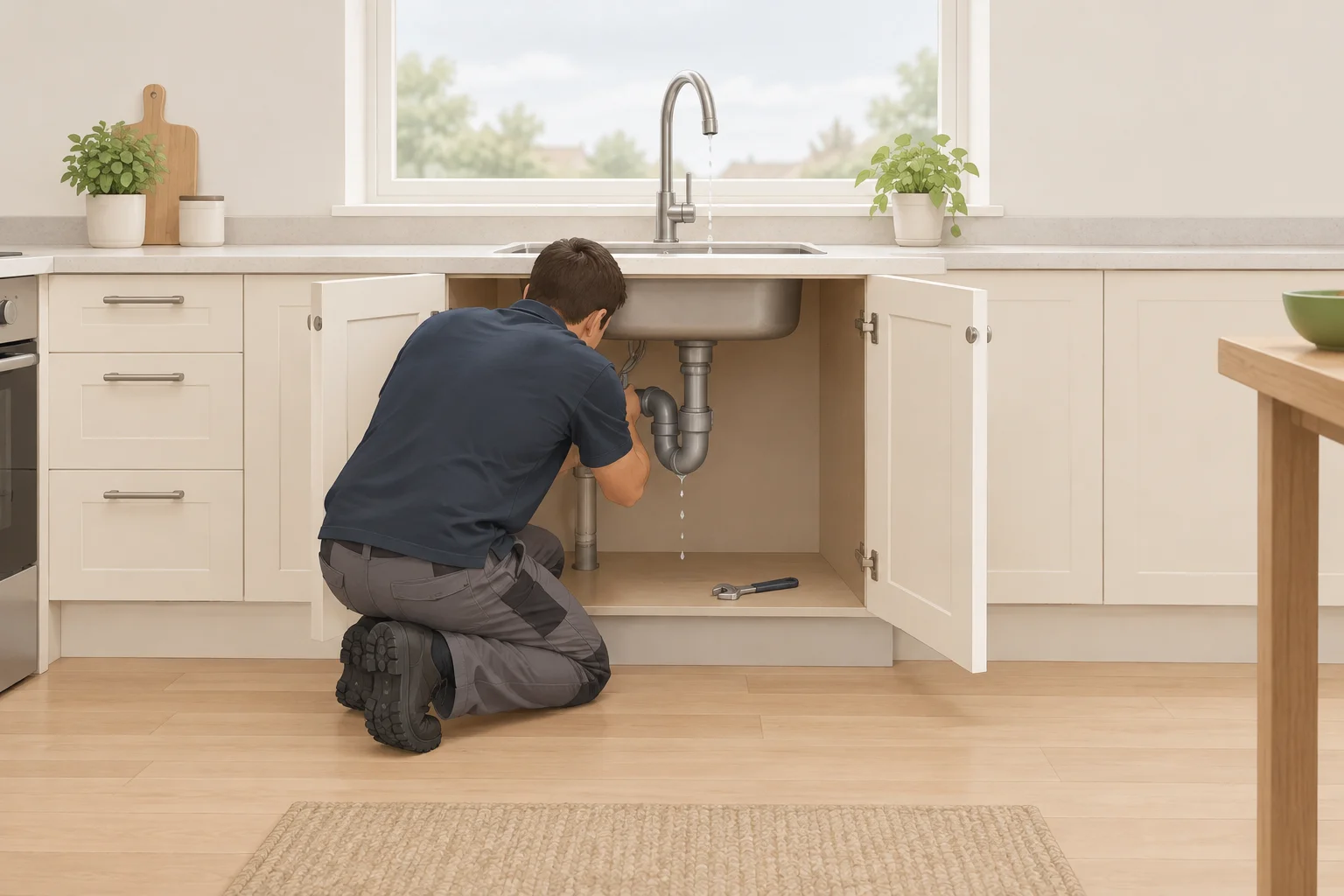
A customer rings. They want a tap swapped, a socket moved or a fence panel replaced. You say you can do Thursday, and you give a rough price. Nobody mentions a quote. Then the job finishes and the customer says, 'I thought it would be cheaper.' Or you find the work is bigger than either of you thought. This post covers when a phone call is enough and when a short written quote is worth the two minutes.
This is general information, not legal advice. It mainly covers customers who are ordinary householders (consumers). If your situation is unusual, check with Citizens Advice, trading standards or a solicitor.
The short answer
The Consumer Rights Act 2015 doesn't say you must send a written quote. A verbal agreement can be a real contract. The risk isn't that a phone price is illegal. The risk is that nobody can prove what was said.
So the practical answer is this. For a tiny job from a customer you know, a verbal price can be fine: no law says a quote for a small domestic job has to be in writing, and a price agreed by phone can still form a binding contract. For anything where price or scope could be argued over, put it in writing. A text or email is the simplest record of what you agreed, and it takes less time than a formal document.
What you say on the phone can bind you
Under section 50 of the Consumer Rights Act 2015, anything you say or write to a consumer about yourself or the service is treated as part of the contract. That applies if the customer takes it into account when deciding to go ahead, or when making a later decision about the work.
So if you say 'about £120, easy job' and they book you on that basis, that statement can count. There are two limits. One is anything you said or wrote on the same occasion that qualified it, such as 'that's if the pipe is accessible'. The other is a change you and the customer expressly agree, before or after the contract.
That second point is why a written note helps. It records both the price and the qualification you gave.
What happens if no price was agreed
If nothing fixes the price or says how it is worked out, section 51 adds a term. The consumer must pay a reasonable price, and no more. What is reasonable is 'a question of fact', so a court decides case by case. There is no formula.
The explanatory notes to section 51 give the example of a plumber fixing an urgent leak, where the householder may not stop to discuss price first. A reasonable price applies there. The same notes say that for ordinary contracts the trader should give price information before the consumer is bound.
In plain terms, if you leave the price open, you are leaving it for someone else to decide later.
Quote or estimate: say which one you mean
Many tradespeople treat a quote as a fixed price and an estimate as a best guess. That is the common understanding rather than a rule set out in law, so whichever word you use, say clearly on the document whether the price is fixed or could change, and what would change it.
What does follow from section 50 is that what you say can bind you. If you mean a guess, say so clearly, and say what could change it. 'Roughly £100 to £150, depending on what I find behind the wall' is far safer than 'about £120'. Better still, send that sentence in a text.
When a verbal agreement is usually enough
The job is small and the price is obvious, such as a fixed call-out charge you have told them before.
The customer is one you work for regularly and you both know how you charge.
It is an emergency, such as a burst pipe, where the first job is to stop the damage. Even then, tell them your call-out and hourly rate when you can, and write down what you did and what it cost.
The work is done on the day and paid for on the day.
When you should put it in writing
The price depends on things you can't see yet, such as hidden pipework, wiring behind walls or the condition of a roof.
Materials are a big part of the cost and you or the customer are supplying them.
The job could grow. Customers often add 'while you're here' extras.
There is more than one visit, or a start date a few days or weeks away.
The customer is new to you, or someone other than the person paying is giving instructions.
The customer is a landlord, a letting agent or a business.
Business customers are different from consumers. The Consumer Rights Act and the 2013 consumer contract regulations protect consumers only. Disputes with businesses depend on general contract law and your own terms. A price agreed verbally can still be binding, but it is much harder to prove, so confirm it by text or email.
Cancellation rights and extras on the same visit
The Consumer Contracts (Information, Cancellation and Additional Charges) Regulations 2013 can give a consumer 14 calendar days to change their mind when a contract is made away from your premises or at a distance. BIS guidance on the regulations says you must give a copy or confirmation of the contract no later than when the service starts. If the customer wants the work to begin inside the 14 days, you need their explicit request, and for off-premises contracts that request must be on a durable medium, such as paper or email. The burden of proving you gave the required information rests with you.
Whether a job booked by phone counts as an off-premises contract depends on where the contract is concluded. Under regulation 5 of the Consumer Contracts Regulations 2013, a contract agreed in the customer’s home with you both there is an off-premises contract. A contract agreed entirely by phone, text or email can be a distance contract instead, if you sell that way as an organised scheme. Most trade jobs priced on a site visit and agreed there are off-premises contracts.
The guidance also says a customer who called you out for emergency repairs has no right to cancel those repairs. But non-urgent extra work agreed on the same visit does carry cancellation rights. Its example is a burst pipe fixed at once, then new lagging agreed afterwards. You should tell the customer about those rights before agreeing the extra work.
Two limits apply to off-premises contracts. If the customer pays £42 or less, the information and cancellation rules don’t apply at all (regulation 7(4)). For urgent repairs or maintenance the customer asked for, done straight away and costing £170 or less, a lighter set of information rules applies (regulation 11).
What a short written quote should say
It doesn't need to be long. The Competition and Markets Authority's unfair commercial practices guidance lists the key information a customer needs: the main features of what you are offering, the total price, who you are and your address, and any cancellation rights. A one-page quote can cover all of that.
Your name, business name if you have one, and address.
The customer's name and the address of the job.
What you will do, in plain words, and what is not included.
The price, and whether it is fixed or an estimate. If it is an estimate, say what could change it.
Whether materials are included, and roughly how much.
How extras will be handled: 'any extra work will be agreed with you and priced before I start it.'
The start date and how long you expect it to take.
When and how you want to be paid, and any deposit.
For help working out the number itself, see how to price a job and protect your margin. If the job is big enough to need a deposit, see deposits and stage payments.
A quick example
Suppose a customer rings about moving an outside tap. You say it should be about £90. When you arrive, the old pipe is corroded and needs replacing back to the stopcock. If all you have is a phone call, you and the customer are now arguing about what 'about £90' covered.
If you had texted, 'Moving the outside tap: £90 for labour and fittings, assuming the existing pipe is in good condition. Extra pipework would be priced and agreed with you first,' the conversation is simple. You have the qualification on record and a clear way to agree the extra.
Wrapping up
You aren't legally required to send a written quote for a small job. But what you say on the phone can bind you, and if no price is agreed, a court may decide what is reasonable. A short text or email after the call fixes price, scope and the 'what if it's bigger' question. Do it for anything uncertain, and when in doubt, do it anyway.
If you want to do this quickly from your phone, Quidjob lets you turn a call into a simple quote and send it to the customer before you pick up your tools.
If you're quoting there and then, Sending a quote from your phone on site: what to put in it covers what to include.