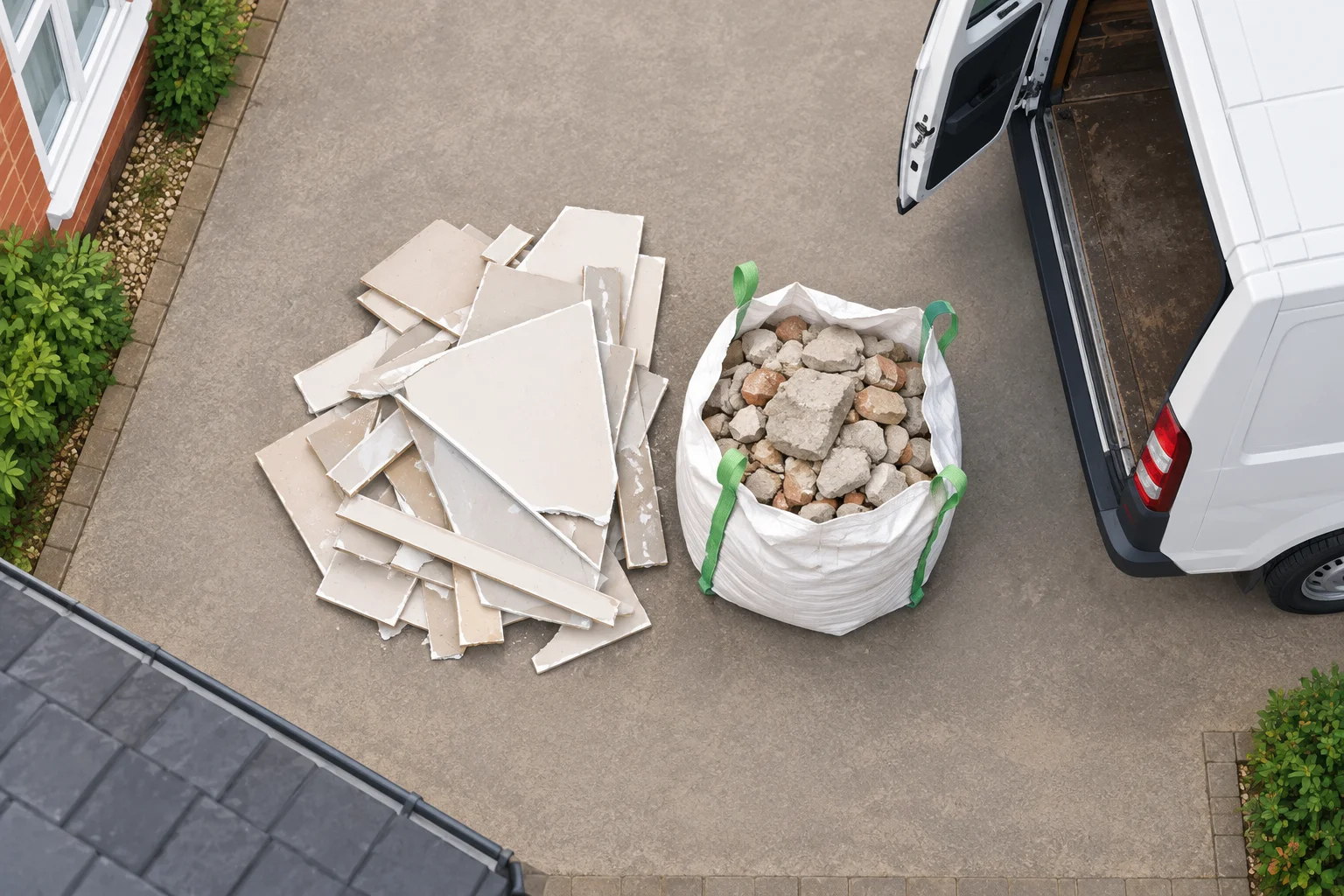
The job is done, the customer is happy, and then someone asks about the pile of plasterboard offcuts by the van. Who takes it away, and who pays? If the quote said nothing, you are left to eat the cost or have an awkward conversation.
This post covers who is responsible for waste from a job, what the official guidance says about the cost, and what to write in your quote so it is settled before you start. It is general information, not legal advice. If your job is unusual, check the official pages linked below.
Who is responsible for the waste you produce
The government's Waste duty of care code of practice names tradespeople, including electricians, builders, glaziers and plumbers, as waste producers. When you work on a customer's property, you are responsible for the waste you produce. That includes getting it transported and disposed of properly.
The code is issued under section 34(7) of the Environmental Protection Act 1990 and relates to the duty of care in section 34(1). This is the 'duty of care': a legal duty to keep waste under control and pass it only to someone authorised to take it.
On cost, the code is plain. It says the cost of disposal should be included in what you charge for the work. The customer's own duty of care does not apply to waste you produce, because they are not the one passing it on.
So the starting point is that waste from your work is your cost to cover. You do that through your price. Treat it as a cost like fuel or materials, not a favour or a surprise extra.
When the customer's waste is a different matter
The code has an exception. If the customer adds their own waste to your skip, or asks you to take away waste they produced, the duty of care applies to that waste too. It stops being just your offcuts.
In practice, this is where disputes start. A customer sees an empty skip on the drive and puts the old shed, the broken patio chairs and a mattress in it. Your quote priced for a bathroom strip-out, not a house clear-out.
What to put in the quote
The notes from the official sources show no legal requirement to name waste in a quote. Itemising it is good practice, because it makes the cost visible and sets limits. A short waste section covers most of it.
What is covered: say that removal of waste from your own work is included, such as offcuts, packaging and stripped-out fittings.
How it leaves: say whether you will use a skip, a hired waste carrier or your own van, so the customer knows what to expect on the drive.
Cost: either show a separate line, for example 'Waste removal: £180', or say it is included in the price. Pick one and be clear.
What is not covered: say that the customer's own waste, such as garden waste or old furniture, is not included unless agreed in writing.
Extra loads: say what happens if the customer adds to the skip or the job produces much more waste than expected, and that you will agree any extra cost with them first.
Permits: if a skip would need to stand on the road, say who arranges any permit. Check with the council, as the notes give no figures or rules for this.
Hazardous waste: say that anything hazardous, such as asbestos, is excluded unless you have specifically priced it.
A simple worked example
Say you quote a bathroom refit. You expect about a skip's worth of old tiles, plasterboard and fittings. Your quote might read: 'Removal and disposal of waste from the bathroom work is included. Customer's own items or waste from other rooms are not included. If more waste needs removing, I will tell you the extra cost before I do it.' The figures here are only an illustration. Use your own costs.
That wording costs you a few lines and gives you something to point to if the skip fills up with the garage clear-out. For more on building a price that protects your margin, see how to price a job and protect your margin.
Check who is taking the waste
If you hire a skip firm or other business to take the waste, check that it is an authorised carrier with up-to-date, valid upper tier registration. Registration numbers start CBDU followed by numbers.
Keeping a record of the check is not a legal requirement, but the code says it helps if waste is later fly-tipped. It suggests keeping:
the carrier's registration number
a receipt showing the registered operator's business details
a photo or copy of the registration
Paperwork for each load
GOV.UK says a business must complete a waste transfer note for each load of waste that leaves its premises, and must check the carrier is registered. The code says a written description of the waste must be agreed and signed by you and the next holder. You can use another document, such as an invoice, as long as it has all the required information.
Under the Environmental Protection (Duty of Care) Regulations 1991, a transfer note must:
identify the waste, with its quantity and whether it is loose or in a container, and what kind of container
give the time and place of the transfer
give the names and addresses of the transferor and the transferee
state whether the transferor is the producer of the waste
Keep the description for 2 years for non-hazardous waste. If an authorised officer asks for it and you can't provide it, a fixed penalty notice can be issued. Failing the duty of care is an offence, and there is no upper limit on the fine a court can set.
If you carry waste in your own van
Anyone who transports waste has to register as a waste carrier. GOV.UK says an unlimited fine applies if you don't. Registration is usually free if you only transport waste you produce yourself. Otherwise it costs £191.02.
The GOV.UK page doesn't say whether a tradesperson carrying their own construction waste falls into the free case. Check whether you need to register on that page before you start taking waste to the tip in the van.
For hazardous waste such as asbestos, different rules apply. Start with GOV.UK's hazardous waste overview rather than treating it like ordinary rubbish.
Putting it in writing before you start
If you quote from your phone, you can add waste as its own line or note so it is on every quote. Quidjob lets you build quotes on your phone, so a standard waste line can go on each one. Whatever you use, the aim is the same: the customer reads what is covered before they say yes.
Wrap-up
Waste from your work is your responsibility, and the official code says its cost should be in your price. Say so in the quote, set out what is not covered, and agree extras before you do them. Use a registered carrier, keep the paperwork, and check the registration rules if you carry waste yourself. If your situation is unusual, ask an accountant or the relevant authority.