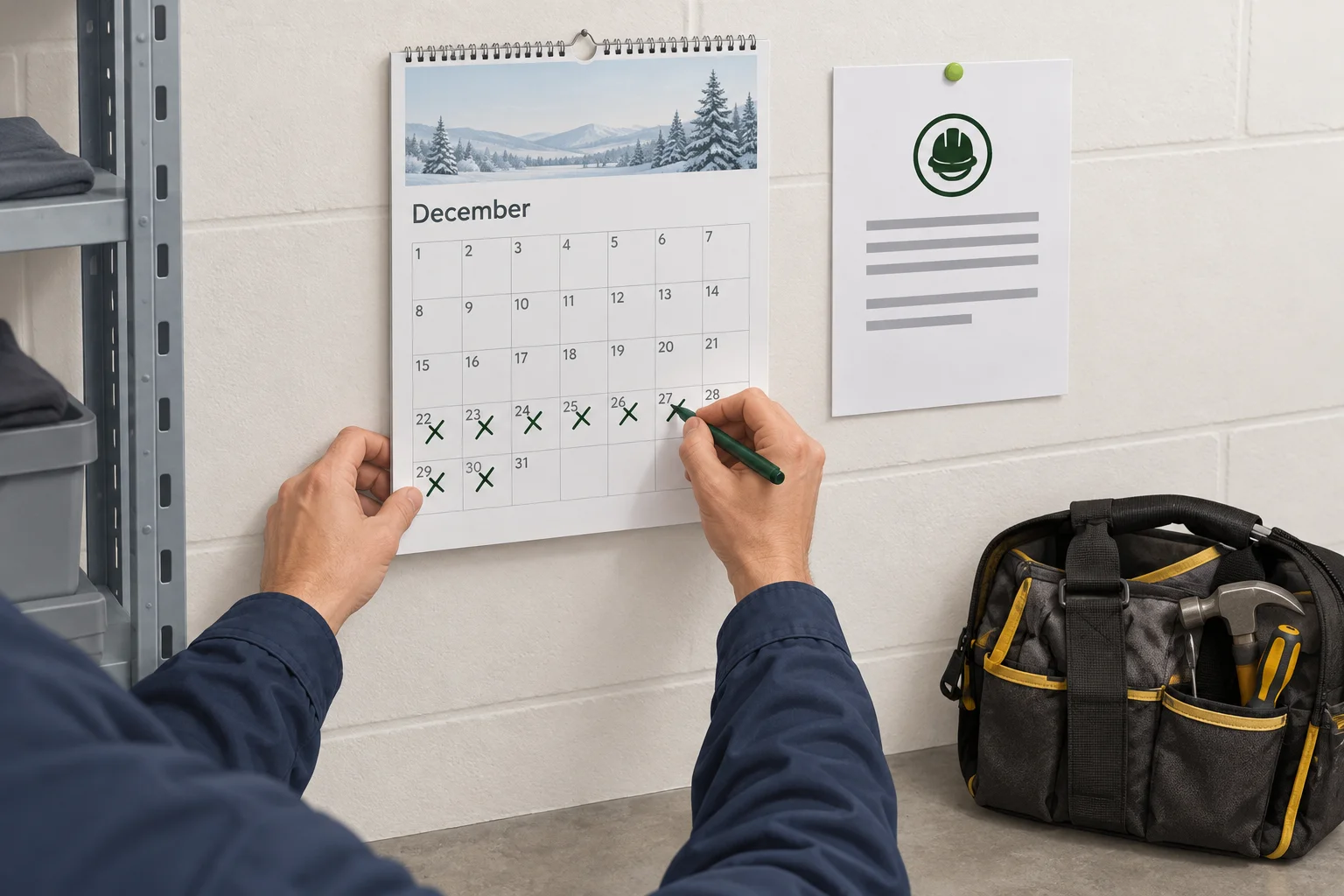
Most customers don't think about your Christmas break until the week before it. Then they ring, wanting a tap fixed or a socket moved before you go. If you haven't told anyone your dates, you end up with double bookings, jobs half finished over the holiday and people who feel let down. A shutdown is easy to handle if you plan it now. It is 23 October 2026, so you have about eight weeks before a typical mid-December finish.
Pick your dates from the real bank holiday calendar
Start with the official dates on UK bank holidays on GOV.UK. For Christmas 2026 they are:
Friday 25 December 2026: Christmas Day in England, Wales, Scotland and Northern Ireland.
Monday 28 December 2026: Boxing Day (substitute day) in all four nations.
Friday 1 January 2027: New Year's Day in England, Wales and Northern Ireland.
Monday 30 November 2026: St Andrew's Day in Scotland, if you work there.
Watch Boxing Day. Saturday 26 December is not the bank holiday this year, because it moves to Monday 28 December. If your notice says 'closed 25–26 December', some customers will assume you are back on Monday 28th, and you may not be. Write the actual dates and the weekday: 'last day Friday 18 December, back Monday 4 January'.
Those two dates are only an example. Choose what suits your trade and your customers. If you are a plasterer or builder, you may want a longer break. If you handle heating, you may want a shorter one.
Tell customers early, and tell the right people first
No rule we can point to says how much notice you must give before a shutdown, so treat it as good practice. A simple order works well:
Customers with a booked job near the break. Contact them one by one, now. Don't rely on a general notice.
Open quotes you haven't had an answer to. Tell them your last start date before Christmas and your first free date in January.
Regulars and repeat customers. A short message with your dates and how to book is enough.
Everyone else. Put the dates in your message signature, on your social media page and on the quote or invoice you send from now on.
Say it more than once. Send the first message in late October or early November, a reminder in early December and a final one in the last week. Keep the words short and put the dates first.
I'm finishing for Christmas after Friday 18 December and back on Monday 4 January. I have a few slots left before the break. Reply by Friday 6 November and I'll hold one for you. Otherwise the first free date is the week of 4 January.
Put start dates in writing
The best protection for your booked dates is a written start date in the quote. For a consumer (a homeowner rather than a business), section 52 of the Consumer Rights Act 2015 applies where the time for the work isn't fixed. In that case the contract is treated as including a term that you will do the work within a reasonable time. What counts as reasonable is 'a question of fact', so it could be argued over.
You avoid that argument by fixing the time yourself. Put in the quote something like: 'Start Tuesday 8 December, finish by Friday 18 December. The next available date after that is Monday 4 January 2027.' Then nobody has to guess what 'reasonable' means across a Christmas gap. Section 52 covers consumer customers only, not business customers, but a written date helps with both.
Hold your booked dates
Most cancelled bookings in December come from vague arrangements, not bad customers. A few habits help.
Confirm every booking in writing with the day, the rough time and what you will do.
Reconfirm a week before. A short message such as 'Still OK for Tuesday?' catches changes early.
Say what happens if the job overruns. Is it finished before Christmas, or does it wait until January? Agree this before you start.
Ask for a deposit on bigger jobs so a booking means something. Our guide to deposits and stage payments covers how to word this.
Keep a short waiting list. If someone drops out, you can offer the slot straight away rather than lose the day.
Be careful about promising what a customer can reclaim if they cancel. That depends on your contract and on consumer rules, so check the official guidance or ask an accountant or solicitor before you write it into your terms.
Decide what you will do about urgent work
Someone will always have a leak or a dead socket on 27 December. Decide before you close whether you will take any urgent calls. If you will, say so, and say what you charge. If you won't, say that too, and tell people to find another local tradesperson. Either way, you stop the calls turning into awkward conversations. Don't offer cover you can't give.
Get invoices out before you shut
A two-week break with no income is easier if you aren't waiting on money for jobs you finished in November. Send invoices the day each job ends, with your bank details and a clear due date. Check that you haven't let any slip, and chase anything overdue before the break. If a customer is slow, our guide on how to chase a late invoice and claim interest shows the steps.
Wrap-up
Choose your dates from the official calendar, tell booked customers first, and put start dates in every quote. Reconfirm bookings, decide on urgent calls and invoice before you go. If you quote and invoice with Quidjob, the quote can carry your start date, and the invoice link lets customers pay by bank transfer, so you can enjoy the break knowing the paperwork is done. This is general information, not legal advice. If a customer disagrees about their rights, check GOV.UK or speak to a solicitor.