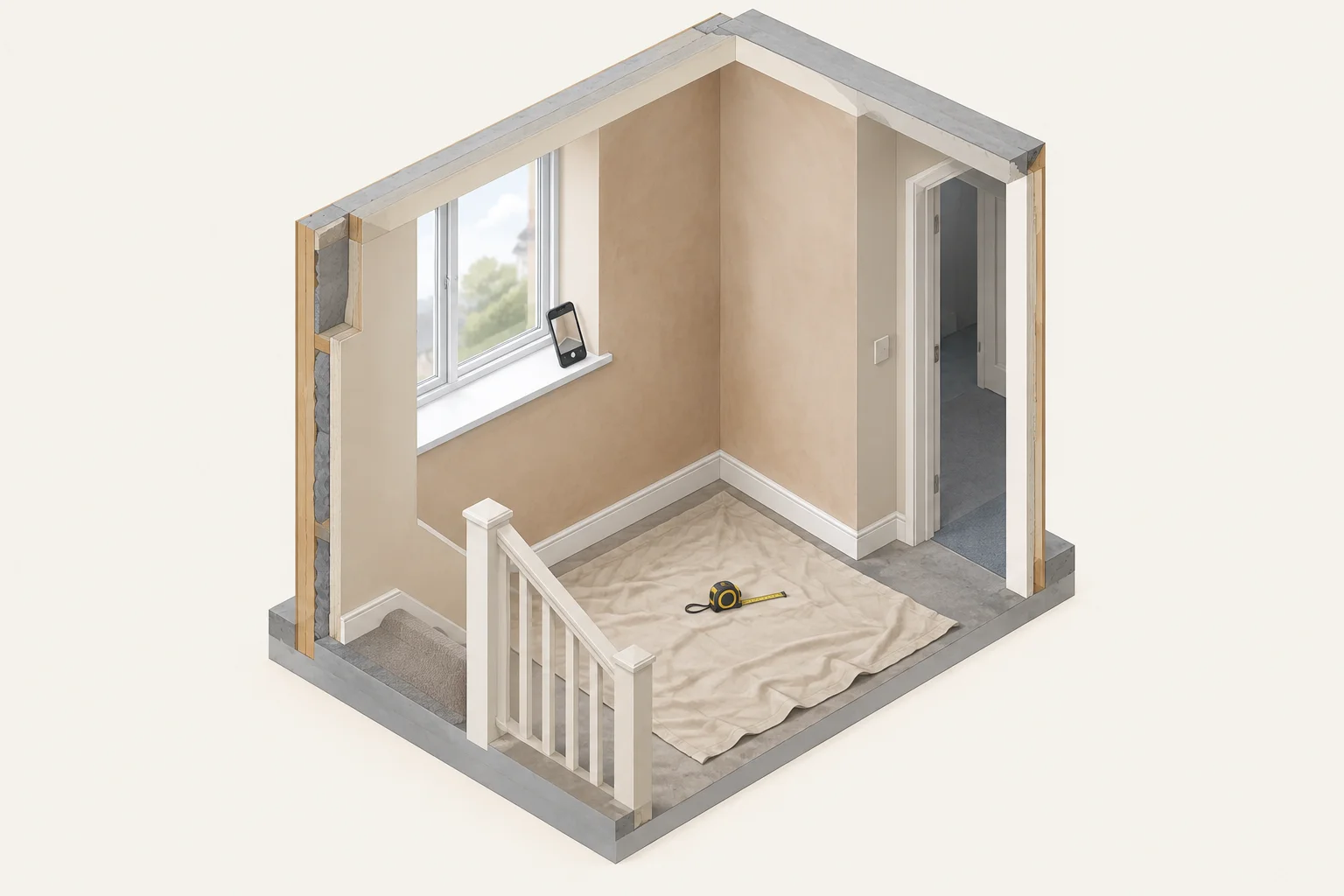
Most arguments with customers come down to one question: what was it like before, and what did we agree? Memories differ. A dated photo does not. It takes seconds on your phone and it can save you a lot of unpaid time.
This is a checklist of what to photograph and when. It is general information, not legal advice. Photos help you show your side, but nothing says they are legally required, and no one can promise how much weight they will carry if a dispute goes further.
Why photos matter for the paperwork you already have
The law already treats what you say and write as part of the deal. Under section 50 of the Consumer Rights Act 2015, anything said or written to a customer by you or on your behalf, about you or the service, becomes a term of the contract if the customer took it into account when deciding to hire you. That includes your written quote, your messages and your scope notes.
Section 50 also says that information can be qualified by something said or written on the same occasion, or changed by a change you both expressly agree, before or after the contract is made. So a clear written record of an agreed change helps you. A photo of the site, taken with a note of what was agreed, backs that record up.
There is also a duty on you. Section 49 of the same Act treats every consumer service contract as including a term that you must carry out the service with reasonable care and skill. If a customer says you damaged something, or that your work is not good enough, photos taken at the time are the best evidence of the real state of things.
Before you start: photograph how things are
Take these photos before you lay a dust sheet or move a tool. Take a wide shot first, then close-ups.
The whole room or area from the doorway, so the layout and condition are clear.
Existing damage: scratches on floors, chips in baths or sinks, cracks in plaster, marks on worktops, stained ceilings. Get close and include something for scale, such as a tape measure.
The route in: hallway walls, stair carpets, door frames and the floor you will walk across with materials.
What you will work on: the old boiler, consumer unit, pipework, window or wall, from more than one angle.
Anything you might be blamed for: a loose tile, a damp patch, an old leak, wiring that is already messy.
Hidden-risk areas once opened up, such as what is behind a panel or under floorboards, before you change anything.
Check that the photos are in focus and that the damage can actually be seen. Take the photo again if it is not clear. Ask the customer first if you need to photograph a room with personal items in it, and keep those out of frame where you can.
During the job: photograph extras and hidden work
Extras are where most price arguments start. If no price has been fixed and none has been paid, section 51 of the Consumer Rights Act 2015 says the customer is treated as having to pay a reasonable price, and what is reasonable is a question of fact. That is a weaker place to be than a price agreed in writing.
So agree the price of an extra in writing before you do it. Then take a photo of the reason for it.
The problem you found: rotten joists, corroded pipe, a wall that is out of true, wiring that is not safe to reuse.
The customer's request if they ask for something new on site, such as an extra socket or a moved radiator. Send a message with the price and ask them to reply to confirm, and keep the photo with it.
Work that will be covered up: pipes before boarding, cables before plaster, insulation before it is closed in. You cannot show this later.
Materials delivered or used if the quote depends on them, such as a particular tile or fitting that was agreed.
At the end: photograph the finished job
The last set of photos shows the job was done and left in good order. Take them before you hand over the keys or ask for payment.
Take a wide shot of each area from the same spot as your before photo, so the two match.
Take close-ups of the finish: sealant lines, paint edges, plaster corners, tiling, joints and fixings.
Photograph anything fitted, with the model or data plate visible if it helps, as this is useful for guarantees.
Show the site left clean: floors swept, rubbish gone, dust sheets removed.
Take a photo of anything the customer signed off, such as a snag list ticked off or a message saying they are happy.
If you hand over a certificate or paperwork, a photo of it is a quick back-up. Which certificates your job needs depends on the work, so check the rules for your trade.
Keep the photos in a way you can find them
A photo you cannot find is no use. Keep it simple:
Make one album or folder per job, named with the customer's surname, the street and the month.
Keep the photos in the order you took them: before, during, after.
Back them up off your phone, so a lost or broken phone does not wipe out your evidence.
Do not edit or crop the originals. Make copies if you need to mark anything up.
How long should you keep them? In England and Wales, section 5 of the Limitation Act 1980 says an action founded on simple contract cannot be brought after six years from the date the cause of action accrued. Keeping job photos for around six years matches that window. Scotland and Northern Ireland have different rules, so check them if you work there.
Tie the photos to your quote and invoice
Photos work best next to the paperwork. If your quote, any agreed extras and your invoice are kept in one place for the job, you can find the photos, the price and the agreed changes together if a customer questions any of them. Quidjob keeps your quotes, invoices and jobs together on your phone, and customers pay by bank transfer from the invoice link, so the record of what was agreed and what was paid sits alongside your photo album.
Wrap-up
Photograph the room before, the problems and extras during, and the finished work after. Keep each job's photos together for about six years in England and Wales. Back them up with written quotes and written agreement to extras. It adds a few minutes to each job, and it can save you hours if a customer disputes damage, price or completion.