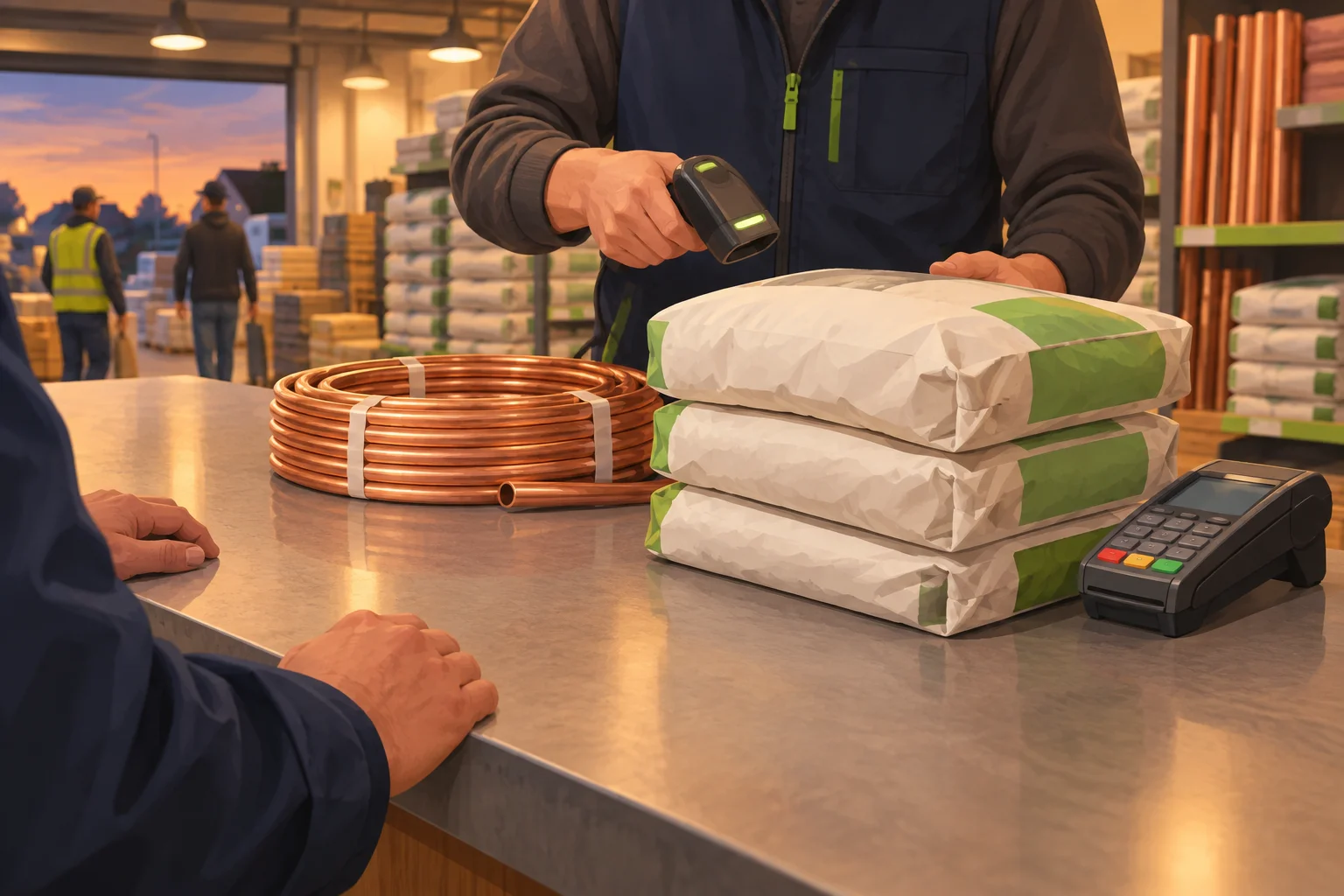
You pop into the merchant on the way to a job and put £120 of fittings on your card. The customer pays you for those fittings on the invoice. Two weeks later you can't find the receipt, and you're not sure whether you charged for everything on it.
That is the problem with re-charged materials. There are two sets of figures to keep: what you paid, and what you billed. If either one goes missing, you either under-bill the customer or miss an expense at tax time. This post shows what to keep and how to line the two up.
Why you need to prove both sides
As a sole trader you must keep records of all your sales and income and all your business expenses. That is in HMRC's guidance on what records to keep. You don't send these records in with your tax return. You keep them to work out your profit or loss, and to show HMRC if it asks.
With re-charged materials, the invoice is your proof of the sale. The receipt is your proof of the cost. Put together, they show the money in and the money out for that job.
What to keep for the cost
HMRC lists the types of proof you should keep. They include all receipts for goods and stock, bank statements, and sales invoices. For a card purchase, that means two things:
The itemised receipt. It shows what you bought, the date, the supplier and the amount.
The card statement line. It shows the money actually left your account.
Does a card statement alone count as proof? The guidance lists bank statements as proof, but it doesn't say a statement can replace the receipt. The safe habit is to keep both. A statement line saying only a merchant's name and £120 tells you little about what was bought, and for which job.
There are no rules on how you keep records. Paper, photos on your phone or book-keeping software are all fine, as long as the records are accurate, complete and readable. HMRC can charge a penalty if they are not. See Keeping your pay and tax records.
Link each receipt to a job
A receipt on its own is only half useful. You need to know which customer it was for. The simplest way is to write the customer's name or job address on the receipt, or on the photo, the same day. A pile of unlabelled receipts on the van seat turns into guesswork a week later.
Records must also let you identify business transactions. A note saying which job the materials were for does exactly that.
How to show the re-charge on the invoice
HMRC doesn't say you must list re-charged materials as a separate line on the invoice. Treat it as good practice, not a rule. It helps you and it helps the customer: they can see what they are paying for, and you can match each invoice line to a receipt.
A simple way to set it out:
One line for labour, with the hours or the agreed price.
One line for materials, with a short description such as 'copper pipe, fittings and valves'.
The materials total, matching the receipts you've kept.
A worked example
You buy £120 of materials for a bathroom job. You agreed with the customer that you'd add 15% to materials to cover your time collecting them and your risk if anything is faulty. That is £18, so you bill £138 for materials.
Your expense is £120. That is the figure on the receipt.
Your income from that line is £138. That is the figure on the invoice.
The £18 difference is what you earn on the materials.
The mistake to avoid is recording only the £18 mark-up, or only the £120 cost. Record the full £138 as income and the full £120 as an expense. Agree any mark-up in your quote before you start, so the customer isn't surprised. Our guide on how to price a job covers how to protect your margin when material prices rise.
Keep private items off the claim
You can't claim goods or materials bought for private use. If one receipt has £120 of job materials and a £15 item for your own house, only the £120 is a business expense. Mark the private item on the receipt so it doesn't end up in your records by mistake. The relevant page is Expenses if you're self-employed: reselling goods.
Raw materials and direct costs of the work are among the allowable expense categories. Your accountant can tell you how your own situation fits.
Materials you bought but haven't used yet
Sometimes you buy materials for a job that isn't finished at the end of your accounting period. If you use traditional accounting, HMRC's list of records includes the value of stock and work in progress at the end of the period. If that applies to you, keep a note of what was unused and what it cost. An accountant can help if you're unsure.
If you're VAT-registered
VAT adds a wrinkle, so this section only applies if you're registered. HMRC's manual says a disbursement is a payment you make on behalf of the customer to a supplier. You are just recovering your cost, so it is outside the scope of VAT, but only if all the conditions in VAT Notice 700 are met. See VATSC06160 and VTAXPER38000.
Materials you buy, fit and charge for as part of your own job are usually your own purchase, not a payment made on the customer's behalf. That is a general reading rather than HMRC's own wording, so don't treat your re-charges as disbursements without checking the conditions. Ask an accountant or HMRC if you're unsure.
Digital records and Making Tax Digital
Under Making Tax Digital for Income Tax, you or your agent must create and store digital records of your income and expenses. Expenses include the cost of stock. You must still keep the original documents, or copies, such as invoices and bank statements. The detail is on HMRC's page on creating digital records.
If your software reads your bank feed, a card payment may arrive without its Self Assessment category. Some transactions may not appear in full. You are responsible for checking that the records are accurate before you send a quarterly update. Check that each materials purchase sits in the right category and matches a receipt. Our guide to Making Tax Digital for tradespeople explains the wider picture.
How long to keep the receipts
Keep your records for at least 5 years after the 31 January submission deadline of the relevant tax year. HMRC's example: a 2022 to 2023 return sent online by 31 January 2024 means keeping the records until at least the end of January 2029. If records are lost, you must do your best to provide figures, and tell HMRC on the return if they are estimated or provisional. See how long to keep your records.
A simple routine that works
Get an itemised receipt every time you buy.
Write the customer's name or job address on it, or on the photo you take.
Take a photo before the paper fades and store it somewhere you can find it.
When you invoice, add up the receipts for that job and put the materials total on the invoice.
Record the receipt amount as an expense and the invoice amount as income.
Mark private items and take them out of the claim.
Wrap-up
Re-charged materials only cause trouble when the receipt and the invoice drift apart. Label each receipt with a job, bill the materials in a clear line, and record both the cost and the charge. You'll then claim what you spent and bill what you should.
If you want fewer loose ends, Quidjob lets you quote, invoice and keep your records from your phone. That makes it easier to keep materials lines and job records in one place. Customers pay by bank transfer from the invoice link. This is general information, not tax advice. For your own situation, check GOV.UK or ask an accountant.