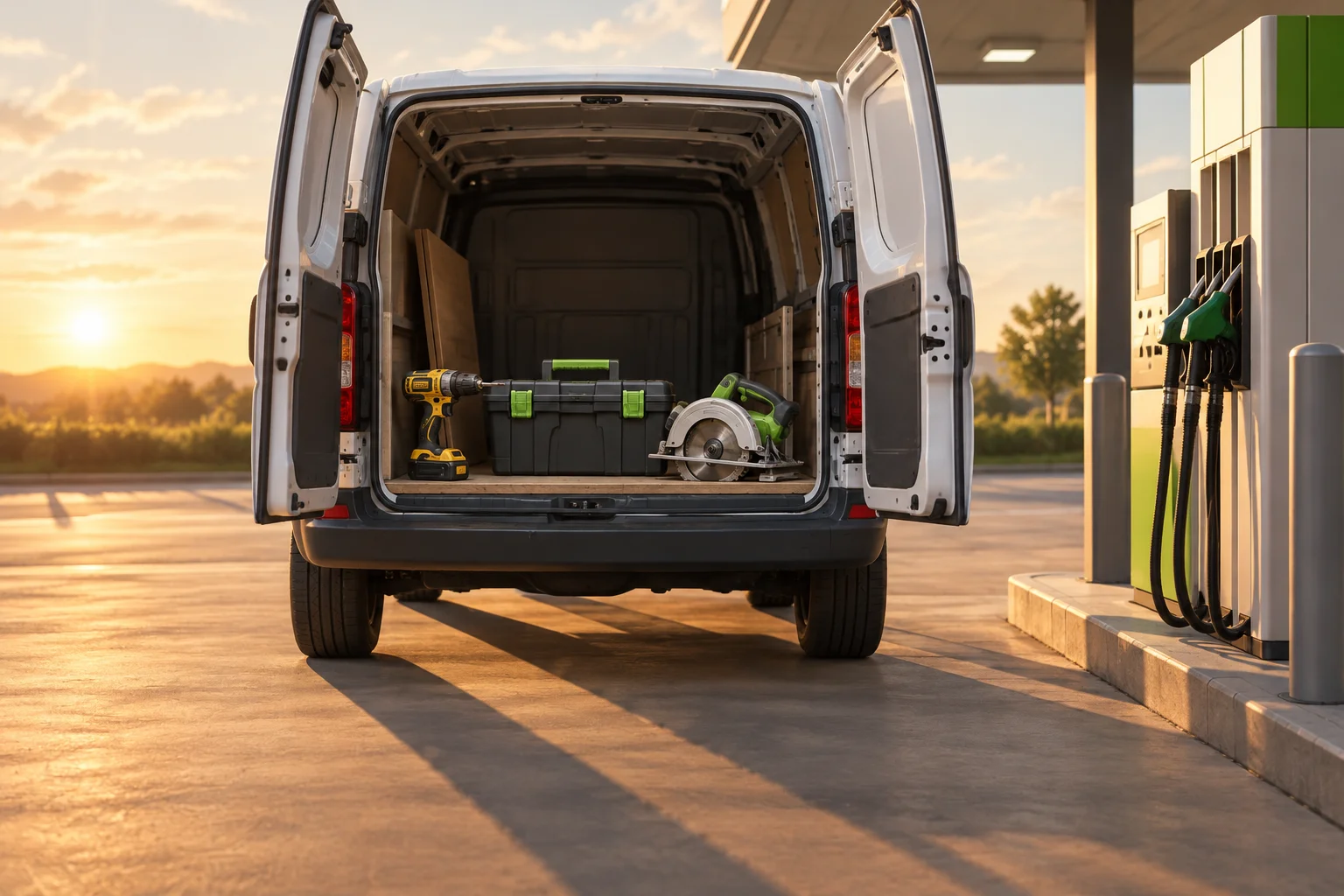
Your van and your tools are probably the biggest things you spend on after materials. Claim them correctly and you pay tax on a smaller profit. Miss them, or claim the wrong things, and you either overpay or risk an enquiry from HMRC (His Majesty's Revenue and Customs). This guide sorts the common costs into what you can claim, what you can't, and how to keep a record that holds up.
It is general information, not tax advice. Your own situation may differ, so check the linked GOV.UK pages or ask an accountant if you're unsure.
How claiming works for a sole trader
As a sole trader you count as self-employed. Allowable expenses are business costs you deduct from your income to work out your taxable profit before Income Tax. The more you can legitimately deduct, the lower that profit.
There are two ways to account for money in and out, and they treat bigger purchases differently:
Traditional accounting: you claim capital allowances when you buy equipment, machinery and business vehicles such as vans.
Cash basis: all items you buy and keep for the business are claimed as ordinary allowable expenses. The one exception is a car, which is claimed as a capital allowance as long as you're not using simplified expenses. Vehicles other than cars, such as vans, are claimed as allowable expenses.
If you don't know which method you use, check your last tax return or ask your accountant before you decide how to record a big purchase.
Van running costs you can claim
GOV.UK lists these as claimable car, van and travel costs:
Vehicle insurance
Repairs and servicing
Fuel
Parking
Hire charges
Vehicle tax licence fees
Breakdown cover
Train, bus, tram, air and taxi fares
Hotel rooms, and meals on overnight business trips
What you can't claim
Non-business driving or travel costs
Fines or penalty charges, such as a parking ticket
Travel between home and work
If the van is also your family vehicle, you can only claim the business share of the running costs. GOV.UK says you can only claim allowable expenses for the business costs, and not for non-business driving, so work out the share of the van's use that is for work (a mileage log makes this easy) and claim that share of fuel, insurance, repairs and servicing.
Actual costs or flat-rate mileage
Instead of adding up every running cost, you can use simplified expenses: a flat rate per business mile. It works for cars, goods vehicles such as vans, and motorcycles. For cars and goods vehicles the rates are 45p a mile for the first 10,000 miles and 25p a mile after that. Motorcycles are 24p.
GOV.UK's example: 11,000 business miles is 10,000 × 45p = £4,500, plus 1,000 × 25p = £250, so £4,750 in total.
The rules to watch:
You can't use flat rates for a vehicle if you've claimed capital allowances on it or included its costs as an expense.
You don't have to use flat rates for every vehicle. But once you use them for a vehicle, you must keep doing so for as long as you use it in the business.
You can still claim other travel costs and parking on top of the flat rate.
That means the choice is not one to make casually. If you pick flat rates, your insurance, fuel and servicing for that van are covered by the mileage rate. Keep a mileage log either way.
Buying a van or tools
Under traditional accounting, the annual investment allowance (AIA) lets you deduct the full value of qualifying items from your profits before tax. It is £1 million for sole traders, and you get a new allowance for each accounting period. That is far more than most one-person trades spend, so a van or a set of power tools can usually be deducted in full in the year you buy them.
There are limits. You can't claim AIA on:
Business cars
Items you owned for another reason before using them in the business
Items given to you or your business
You don't have to claim the full cost at once. You can claim writing down allowances instead, or part AIA and part writing down allowances. Spending above the AIA is claimed as first-year allowances or writing down allowances. The main rate of writing down allowance fell from 18% to 14% a year for Income Tax businesses from 6 April 2026.
Is your van a car for tax?
Vans, lorries, trucks and motorcycles don't count as cars (apart from those bought before 6 April 2009), so you can claim AIA and some first-year allowances on them. For capital allowances, a car is a vehicle that is suitable for private use, is one most people use privately, and was not built for transporting goods. A crew-cab pickup or car-derived van may need a closer look, so check the business cars page or ask an accountant.
Protective kit and clothing
You can claim:
Protective clothing needed for work, such as safety boots and hard hats
Overalls or aprons that protect your everyday clothes, if you only use them for work
Specialist clothing and uniforms that aren't everyday clothing
You can't claim everyday clothing such as suits, shirts, dresses or ordinary shoes, even if you wear them for work. A pair of jeans you wear on site is still everyday clothing.
Other business costs that sit alongside
GOV.UK also lists insurance, subscriptions to trade journals and advertising, including website costs, as allowable expenses. Items such as van signage, racking and a mobile phone are not covered in the pages above, so check the official guidance or ask an accountant before you claim them.
How to record it as you go
Records made at the time are far easier than a pile of receipts in January. A simple routine:
Photograph the receipt or invoice on the day you buy and keep the picture.
Note what it was for and which job or category it belongs to: van, tools, protective kit, or something else.
If it is part business and part private, note the business share and how you worked it out.
Keep a mileage log for every business trip, especially if you use flat rates.
Record large purchases, such as a van or a full tool set, separately with the date and price, as they affect how you claim.
Keep your records for at least 5 years after the 31 January submission deadline for the tax year. GOV.UK's example: for a 2022 to 2023 return filed online by 31 January 2024, keep records until at least the end of January 2029. If you lose records, you must do your best to provide figures, and you must tell HMRC if you're using estimated or provisional figures.
If you are heading into Making Tax Digital for Income Tax, keeping this tidy now will make quarterly updates easier. Read our guide to Making Tax Digital for plumbers, electricians and builders for the detail. Quidjob can keep your Making Tax Digital records from your phone, so receipts and mileage sit with your jobs and invoices.
Wrap-up
Van running costs, work tools and protective kit are all claimable when they are for the business. Fines, home-to-work travel, everyday clothes and private use are not. Decide early between actual costs and flat-rate mileage for each van, know whether you are on cash basis or traditional accounting, and record each purchase on the day. For anything unusual, use the official GOV.UK pages or ask an accountant.